Customer sentiment analysis is the practice of reading what customers write and say, in tickets, chats, emails, reviews and surveys, to tell how they feel about your product, your service and the support they received. It usually relies on natural language processing that labels feedback as positive, neutral or negative. Support teams use it to spot frustration early and act before it turns into an escalation.
In short
- Customer sentiment analysis turns customer feedback into a read on how customers feel, not just what they asked for.
- It covers the customers that CSAT surveys miss, because surveys mostly capture the happiest and the angriest customers.
- The four types support teams use are aspect-based, fine-grained, emotion detection and intent analysis.
- Most teams should start with emotion and intent analysis on past support tickets, because both use data they already have.
- Sentiment works best next to QA scores and agent empathy, so you can see both how the customer felt and how the agent handled it.
What is customer sentiment analysis?
Customer sentiment analysis is a method support team managers use to assess customer feedback quickly and accurately. It looks at the language customers use to decide whether they feel positive, neutral or negative, and about what. The result shows patterns in customer reactions, so the team can build strategies that improve customer satisfaction and experience.
Generally, sentiment analysis relies on algorithms that analyze customer data such as emails, comments, reviews, surveys, and even phone calls. These resources are used to evaluate the language used and determine a customer’s feelings.
This analysis can help to identify customer pains, preferences, and spots that require improvement. It also helps leaders find trends in customer feedback and make better decisions about how to respond to customer needs or issues. In Kaizo, this sits under support insights and analytics, next to root cause and reporting.
If you want the general technique behind it, outside customer service, our explainer on what sentiment analysis is covers the basics.
Why is customer sentiment analysis important?
Customer sentiment analysis matters because you cannot provide a great customer experience without understanding how customers feel. It shows how customers feel about a product or service, including the support they received, and it lets support teams spot issues before they become a larger problem. Tracking sentiment over time shows negative trends while there is still time to fix them.
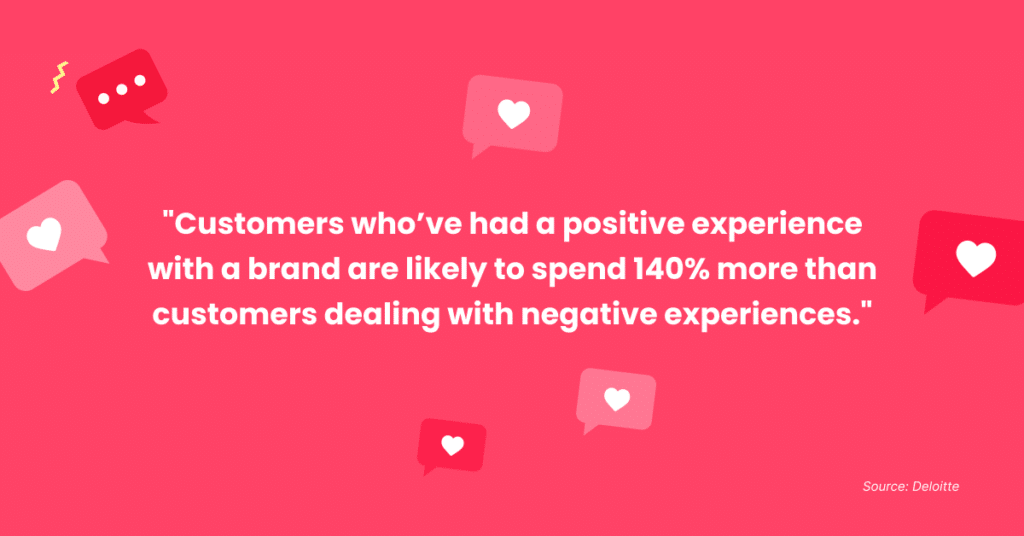
A better look at what your customers think (and feel) about your company lets you make better decisions when you plan and provide the experience. Knowing exactly what they like or dislike about your product and service means you’ll be able to:
- Provide customized experiences
- Offer proactive support
- Make better choices for the future of your product and users
- Increase the return on investment for campaigns multiple departments in your organization are running
- Safely manage your brand reputation and avoid risk escalation
By tracking customer sentiment over time, you can detect negative sentiment trends and address them on time. This is particularly important as it allows you to stay ahead of complaints and keep customer satisfaction rates at peak levels.
Once they understand how customers feel and think, support teams can also create personalized customer experiences to ensure each buyer receives the help they need. In Zendesk’s 2022 CX Trends research, 90% of consumers said they are willing to spend more with companies that personalize the customer service experience.
How can sentiment analysis improve customer experience?
Sentiment analysis improves customer experience by showing trends and patterns that standard support metrics hide. It adds the story behind a number like CSAT, shows which issues frustrate customers from their first message, and tells agents when a reply is likely to make an angry customer angrier. Two customer support leaders explained to us how they use it.
Craig Stoss, Director of CX Transformation at PartnerHero, says the customer sentiment has to match, or alter, the metrics and goals you typically measure within a support context:
“For example, when we report that our customer satisfaction score (CSAT) went up, we know that CSAT is not fully accurate, as it typically captures the happiest and the angriest of customers, not those in the middle.
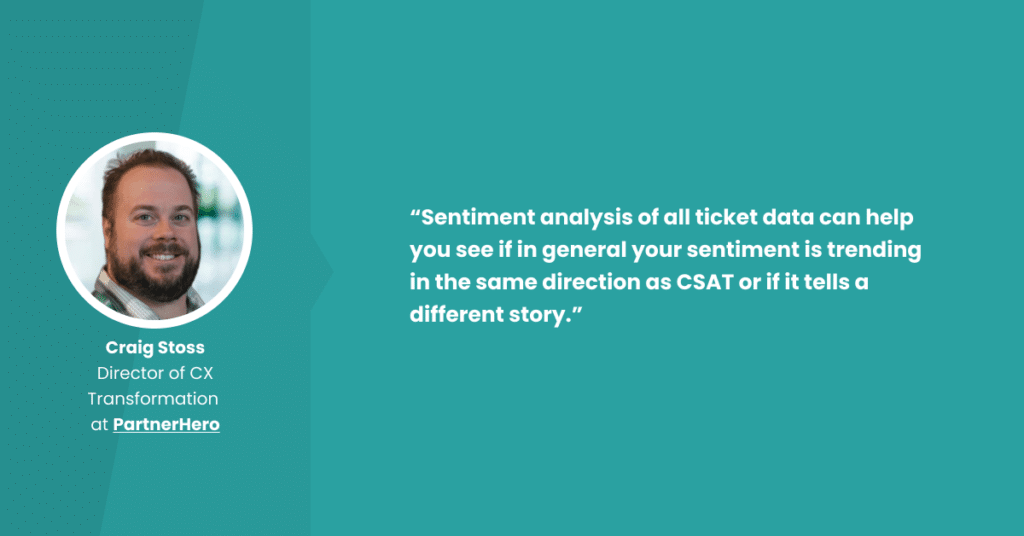
“It’s completely likely that once you aggregate the sentiment from your social media presences, review comments, ticket data, or other data, you will learn something that contradicts the metrics you look at every day. That’s because you’re using a wider set of data that comes without the filters of who responds to surveys and specific pointed questions.”
For Craig, this alone is tantamount to their mission of deeply understanding the customer and partnering with them to create positive customer experiences:
“Sentiment is important to the partnership. When we think about a value conversation with our clients, we know that it isn’t the metric that is the most important, it’s the story behind the metric, what we will do based on that story to improve the metric, and the impact of those actions. Combining all of that alongside the metric gives more value to any support organization.”
If your CSAT and your quality scores tell different stories, our guide on what to do when the QA score and CSAT disagree walks through how to read the gap.
Jaakko Jutila, Vice President of Customer Support at Basware, says that by applying sentiment analysis to the initial and subsequent comments made by a customer, they gain insights into the specific issues that frustrate the customer from the very beginning. This information becomes instrumental in prioritizing product development efforts, allowing them to eliminate frustrating features and enhance the overall product experience.
By analyzing customer sentiment, Jaakko’s team instructs support consultants if a particular response will exacerbate the customer’s anger, enabling agents to provide tailored and effective communication.
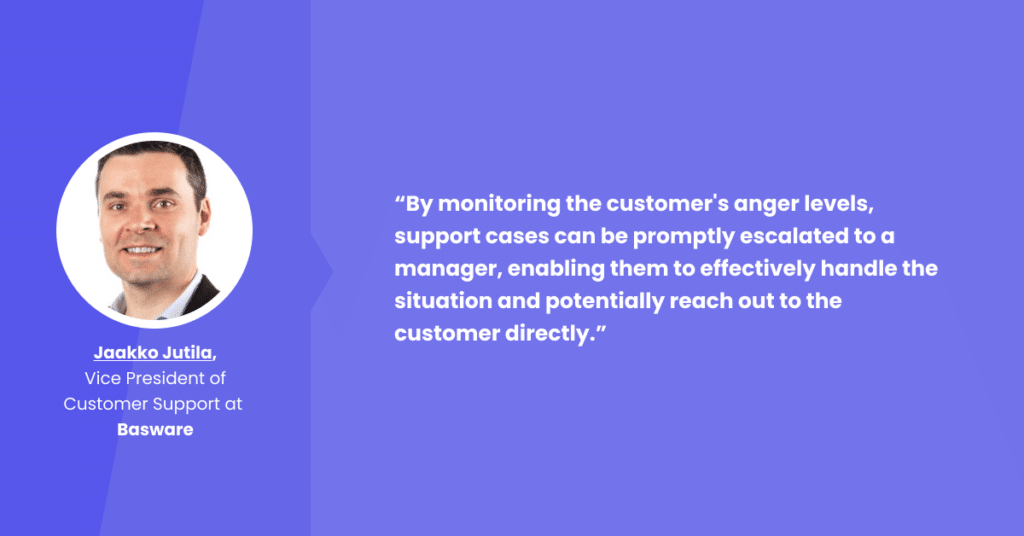
Jaakko further notes that one of the most evident advantages is its ability to prevent ticket escalations:
For the escalation side of this, see how support teams approach escalation handling quality.
What are the types of customer sentiment analysis?
In customer service, there are four core types of customer sentiment analysis: aspect-based analysis, which ties feelings to specific parts of a product or service; fine-grained analysis, which labels words and emotions in detail; emotion detection, which reads tone and attitude in conversations; and intent analysis, which works out what the customer wants to do next.
Aspect-based customer sentiment analysis
What it is:
Aspect-based customer sentiment analysis is a technique that can help you gain deeper insights into what customers think about specific aspects (or elements) of your products or services. This type of analysis goes beyond simply classifying customer feedback as positive, negative, or neutral as it helps you tell which particular aspects customers like or dislike.
This gives customer support teams a more granular look at how customers think. For instance, when you receive a customer complaint, aspect-based sentiment analysis will tell you exactly which parts of a product or service the customer had an issue with by looking at the words they’re using to describe their experience. This lets you identify and fix the root issue behind a complaint before things escalate. Our guide to root cause analysis covers that next step.
How to get started:
To perform aspect-based sentiment analysis, you first need to decide which are the main aspects (elements or features) of your product or service that customers care about.
These can be factors like specific features, pricing, usability, or customer service. As a customer support manager, you’ll want to focus on the latter. This, however, doesn’t mean you should run this analysis independently. In fact, it’s a good idea to pair up with the other departments in your organization.
Once the aspects are clarified, you’ll most commonly use machine learning (ML) or natural language processing (NLP) techniques to analyze large volumes of customer feedback data. Sources for these insights include customer reviews, surveys, social media posts, and support tickets.
Fine-grained customer sentiment analysis
What it is:
Imagine breaking down each sentence into words and classifying them into positive, neutral, or negative ones. By analyzing language cues like emoticons, punctuation, sentiment shifters and intensifiers, an algorithm based on fine-grained sentiment analysis can classify customer messages (even phone calls and audio files) based on the trained sentiment labels.
The insights from fine-grained sentiment analysis can help customer support teams prioritize issues, improve processes, tailor FAQ answers and knowledge base articles, and provide a more targeted response to individual customer queries.
How to get started:
To perform fine-grained sentiment analysis, you’ll need a model that has been trained on a large dataset of text examples labelled with specific emotions like fear, satisfaction, hesitancy, anger, etc. You can then apply this model to customer reviews, comments, emails, transcripts, and surveys.
The output is typically a series of on-text highlights that showcase diverse emotions. Based on these, you can prioritize responding to customers displaying strong negative emotions like anger. Or you can track emotions in time to monitor customers’ responses to a change like new feature updates or interface changes.
Analysis focused on emotion detection
What it is:
Keeping emotions in sight is perhaps one of the most popular types of customer sentiment analysis as it’s easy to apply and doesn’t require setting up complicated AI-based models.
It simply implies focusing on analyzing the tone, emotions, and attitudes expressed by customers in the way they interact with your business through channels like emails, social media, online review websites or surveys, and chat conversations.
So, what’s your goal in this case? To understand how people truly feel about the service and experience your agents offer. For instance, looking through tickets can help you spot negative emotions and opportunities for improvement. This way, you can talk to your agents and put better practices in place for the way agents communicate and talk to customers.
How to get started:
What matters most is understanding how to read these tickets, messages, posts, reviews, or transcripts.
For example, when customers have a negative experience with your support team, they’re often direct when it comes to expressing their frustration and disappointment, even following up several times if needed. But they can also use neutral or even positive language to express this customer dissatisfaction. That’s exactly why it’s best to do the analysis yourself and keep things in context, paying particular attention to subtle dissatisfaction and past interactions.
Remember: Don’t pay attention just to the words customers use. Context, grammar, punctuation, spacing, emojis, and even non-verbal cues can help you detect emotions correctly.
Focusing on intent analysis
What it is:
Want to know exactly what customers will do next or have a rough estimate of when they’ll be ready to make a purchase? Enter intent analysis.
This technique helps agents understand the intent or purpose behind what a customer is saying. Customer support representatives can then provide better, more targeted responses to customer queries. Plus, it’s a great tool if you want to help your sales or product teams with extra insights.
How to get started:
You can tell intent by largely relying on the context. Customers can even use different words to express the same underlying intent. For example, a customer might ask “Can I get more pictures of the product?” or “What are your return policies?” These questions both have some form of purchase intent behind them. The only issue: each of these customers might be at a different lifecycle stage. And that’s exactly where context comes in to help you predict the most likely intent.
By understanding intent at each stage, support agents can improve the responses they provide to make sure they’re not losing a prospect or customer. As a manager, you can dig into past agent-customer interactions to analyze the way your agents respond and make adjustments. Small changes can help you improve first-reply resolution rates, agent productivity, and customer satisfaction rate.
How do you classify customer messages as satisfied, neutral or dissatisfied?
You classify a customer message by reading the words, the context and the history together, then giving it one label: satisfied, neutral or dissatisfied. Words alone mislead, because unhappy customers often write politely. Look at repeat contacts, follow-ups and what the customer asks for next, and label the conversation, not just one sentence.
Here is an illustrative example of three support messages and how a reviewer would label them:
| Customer message | Label | Why |
|---|---|---|
| “That worked, thanks for the quick help!” | Satisfied | Clear positive words and the issue is resolved. |
| “Can you send me the invoice for March?” | Neutral | A plain request with no emotion either way. |
| “Thanks. This is the third time I’ve asked about my refund.” | Dissatisfied | Polite wording, but a repeat contact about the same issue. |
The third row is the one keyword tools tend to miss. It is the “neutral or even positive language” problem from the emotion detection section above, and the reason context matters more than any single word.
How does Kaizo measure customer sentiment and empathy?
Kaizo scores customer sentiment and agent empathy across 100% of support conversations, on every message rather than a sample. Managers can filter to the conversations trending badly, see how agents responded, and judge whether they were empathetic enough. Frustration then shows up as a trend you can act on, not as a cancellation.
With Kaizo, you can turn to tickets to analyze customer sentiment, see how agents respond to tickets, understand whether they were empathetic enough or not, and more.
Kaizo’s Customer Sentiment metric is a valuable tool for assessing customer satisfaction and improving service quality. It provides insights into the overall customer experience and helps identify areas where things may have gone wrong.
Unlike traditional measures like CSAT, this metric goes beyond surface-level ratings and uses natural language processing to analyze the sentiment behind customer interactions.
By detecting negative sentiment early on, it enables proactive issue identification and swift action to address concerns and ensure customer satisfaction. The metric also highlights areas of strength and training needs for support agents, allowing for targeted coaching and improved performance.
Kaizo’s Empathy Score metric is designed to evaluate and measure the empathy levels displayed by customer support agents during interactions. Maintaining a professional, empathetic, and positive approach is crucial for representatives, even in challenging situations.
The AI-driven Empathy Score provides objective measurements of empathy, ensuring consistent evaluations across different interactions and agents. It generates data-driven insights by analyzing language patterns, sentiment, and tone, so the QA team can identify areas of strength and areas where additional training may be needed. Agents receive feedback based on their empathy scores, helping them improve their skills. For how sentiment fits into a scorecard, see sentiment scoring in QA.
That feedback loop is where the time savings show up. EverHelp, a BPO with over 400 support experts, generates coaching cards per agent from their own conversations in Kaizo, and its coaching prep dropped by 75% across sixteen domains.
See it on your own conversations. We will score sentiment across a sample of your conversations and show you the patterns. Book a meeting.
How do you get started with customer sentiment analysis for customer service?
Start with your past support tickets. Pick the conversations that were challenging or took longer than usual, choose one or two types of sentiment analysis, and read for patterns in how customers felt and how agents responded. A mix of emotion and intent analysis is the easiest first step, because it uses data you already have.
If there’s one thing you need to remember right now, it’s that improving customer experience means helping your agents grow. But you can only understand what soft or hard skills need more development by looking at how they interact with customers.
And then there’s the second part of it all: understanding customer sentiment, needs, and pains to better tailor future interactions.
To get a good grasp of customer sentiment (as well as agent performance while you’re at it), start by analyzing past support tickets. Choose tickets that were challenging or took longer than usual to complete. It’s then up to you to decide on which type of sentiment analysis you want to use.
You can opt to perform all four types of customer sentiment analysis, but this won’t be a good solution if you’re looking to get quick results. We recommend choosing a mix of emotion and intent-based analysis to begin with as they’re easier to implement and require resources you already have such as access to support tickets, customer reviews, or surveys.
When is customer sentiment analysis not the right tool?
Customer sentiment analysis is not the right tool when you have too little feedback to show a pattern, or when you need to know whether an agent followed a process. A team handling a handful of tickets a week learns more from reading every one. Sentiment tells you how the customer felt, not whether the answer was correct.
A few honest limits to keep in mind:
- Low volume. With a few dozen conversations a week, read them yourself. Automated sentiment adds little when you can see every ticket.
- Polite dissatisfaction. Customers can use neutral or even positive words while being unhappy, so a sentiment label without context can mislead.
- Correctness and compliance. A happy customer can still have received a wrong answer. That is what a QA scorecard checks, not sentiment.
- No plan to act. Sentiment data only pays off if someone owns the follow-up: coaching, a product fix or a process change.
When you are ready to connect sentiment with root cause and reporting, start with Kaizo’s support insights and analytics, or book a meeting to see it on your own tickets.
Frequently asked questions
What is an example of customer sentiment analysis?
A support lead reviews last month’s tickets and labels each one satisfied, neutral or dissatisfied. A message like “Thanks. This is the third time I’ve asked about my refund” is labelled dissatisfied despite the polite wording, because it is a repeat contact. Grouping those labels by topic then shows which issues frustrate customers most.
What data sources does customer sentiment analysis use?
It uses any place customers express themselves in their own words: support tickets, chat conversations, emails, surveys, online reviews, social media posts and transcripts. A wider set of sources gives a fuller picture, because survey answers only come from the customers who choose to respond.
Is customer sentiment analysis the same as CSAT?
No. CSAT is a score customers give when they answer a survey, and it typically captures the happiest and the angriest customers. Customer sentiment analysis reads the conversations themselves, so it also covers the customers in the middle who never answer a survey.
Can sentiment analysis prevent escalations?
It can help. When negative sentiment is detected early in a conversation, a manager or agent can step in while the issue is still recoverable. Basware’s support team uses sentiment to tell agents when a particular response is likely to make an angry customer angrier.
Which type of customer sentiment analysis should I start with?
Start with a mix of emotion detection and intent analysis. Both are easier to implement than aspect-based or fine-grained analysis, and both use resources you already have, such as support tickets, customer reviews and surveys.
How does sentiment analysis help coach support agents?
Sentiment shows how customers felt during conversations with each agent, and empathy scoring shows how the agent responded. Together they point to specific conversations to coach on, so feedback is based on evidence rather than a general impression.