
Imagine a customer support team without quality management.
Customers may be left confused by contradictory responses from different agents. Mistakes might go unrecognized, and issues might take a very long time to resolve. And now the figures: two or three negative experiences will cause 92% of consumers to leave a business.
Sustainable quality management, however, can turn your customer service from good to exceptional.
In this article, we’ll shed light on the specific roles of quality assurance (QA) and quality control (QC)—two complimentary yet distinct players in the quality management game. You’ll learn about the critical differences between them and get handy tips to transform your service.
Why a solid quality management system in customer service is a priority?
Implementing a robust quality management system with QA and QC measures is the wisest investment. Just think of this — a 5% increase in customer satisfaction can lead to a 25% increase in profit.
Here’s how QA and QC can help you achieve this:
- Get ahead of consumer frustrations: Preventing mistakes and guaranteeing a seamless experience to your clients, QA proactively finds possible problems in service procedures.
- Make every interaction a good one: QA sets clear rules for every interaction, ensuring constant, excellent service from any agent a customer contacts. This fosters loyalty and trust — exactly what a recent survey found 76% of B2B consumers want.
- Fast and effective issue resolution: Fast solutions are the result of QA’s process streamlining and tooling of agents, which also results in satisfied customers. QC, meantime, makes sure agents can keep these promises, saving important customer time.
- Transform feedback into actionable insights: Quality management identifies areas in which agents might require more training. Through analysis of typical mistakes and comments, you can create focused training courses that will keep your staff’s skills sharp and guarantee outstanding service delivery.
Take Amazon’s customer support as a prime example. They had to deal with growing customer expectations, but by putting strong QA and QC procedures in place, they greatly increased customer satisfaction ratings. Tight quality monitoring, a clever feedback loop, and extensive training for customer service agents. Customers became passionate supporters because this winning combination guaranteed them consistently excellent service.
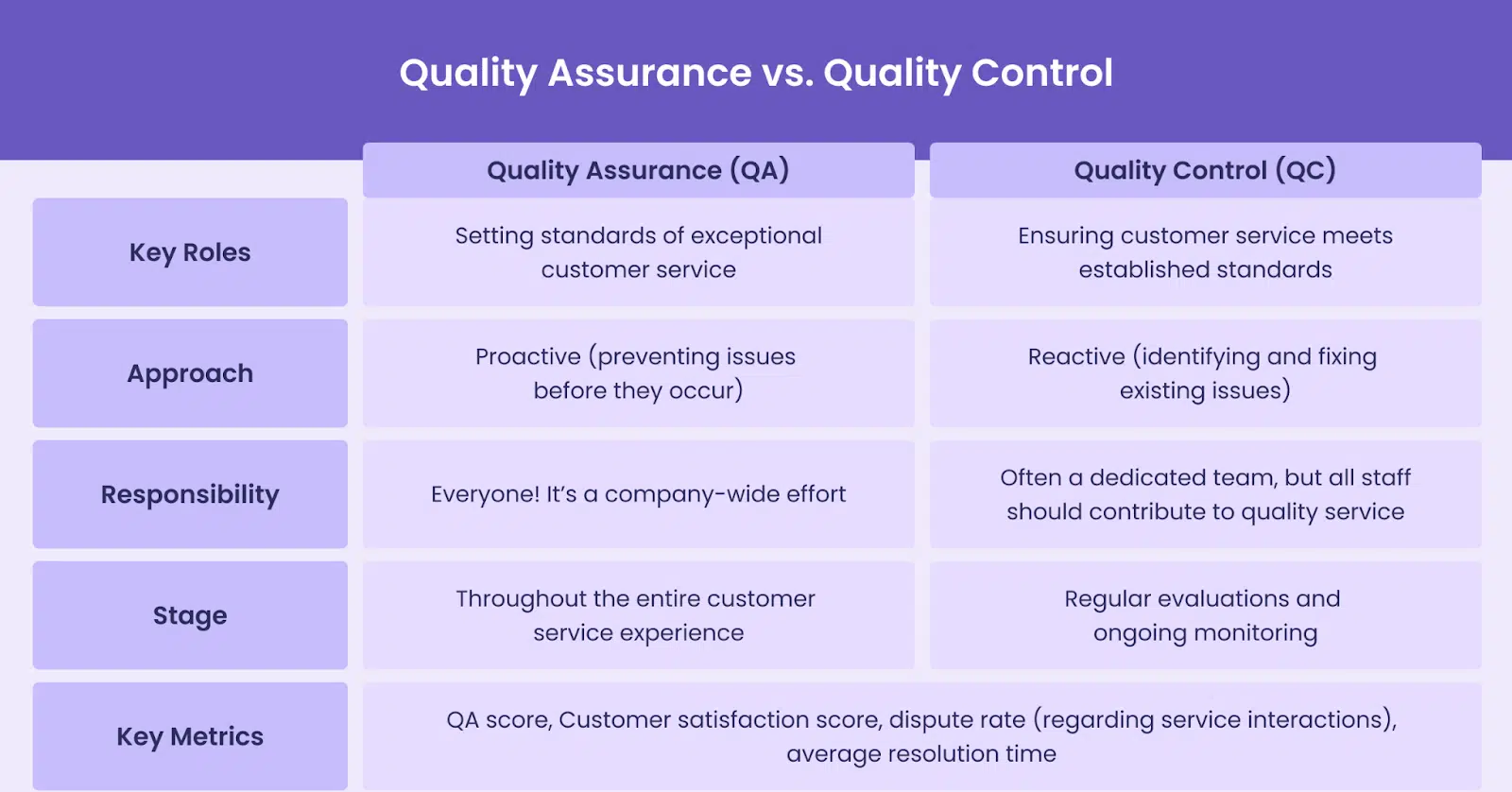
Quality assurance vs. quality control: Roles comparison
Key roles
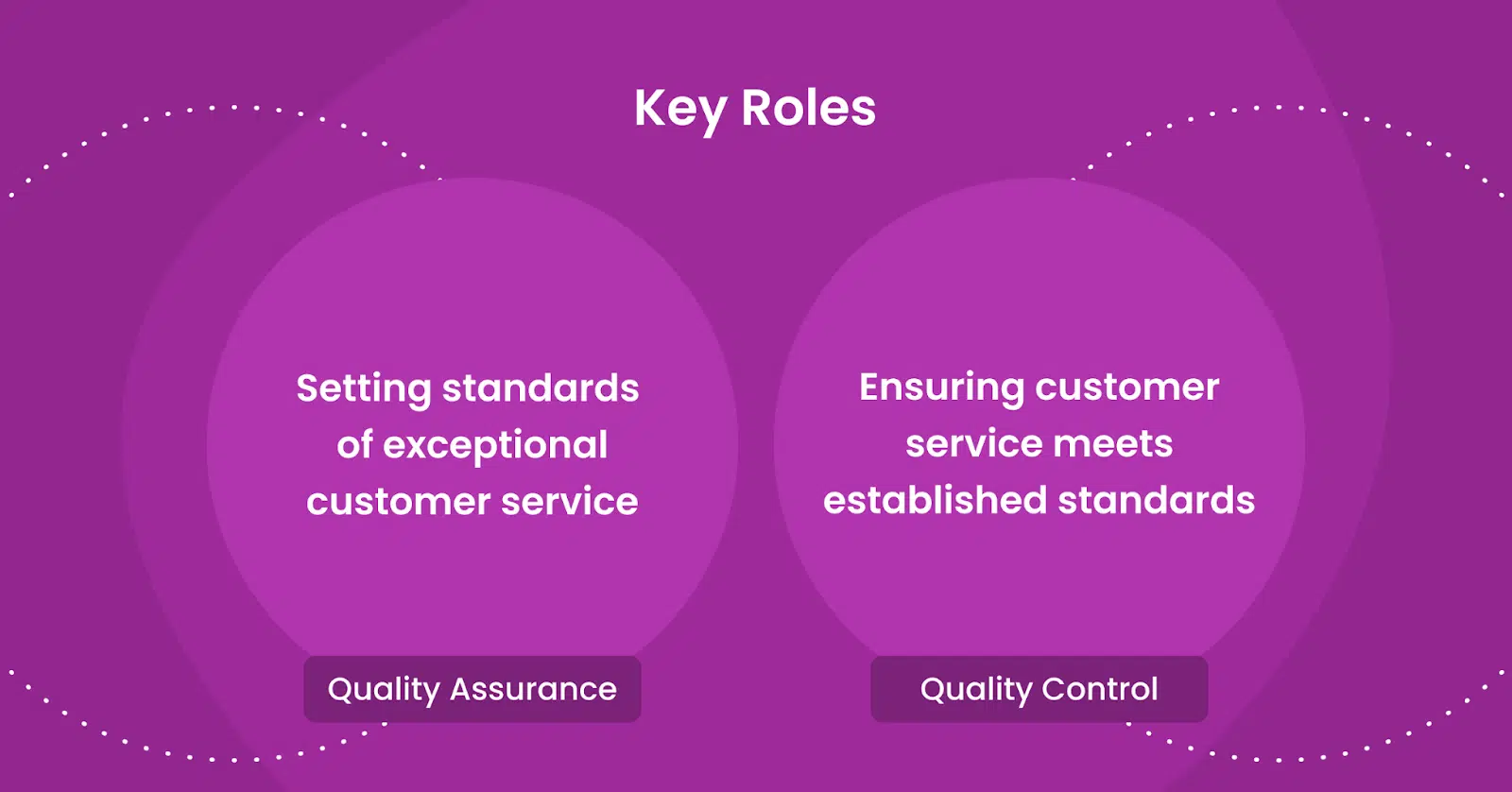
QA focuses on setting the standards and procedures that ensure consistent, high-quality service interactions.
QA activities include:
- Defining clear communication guidelines for customer support representatives.
- Identifying potential areas where service could fall short.
- Implementing training programs to equip representatives with the skills to excel.
- Regularly reviewing and updating customer service processes for optimal efficiency.
Meanwhile, QC monitors and evaluates customer service delivery to ensure it meets established standards.
QC activities include:
- Regularly evaluating customer service calls, emails, and chat interactions.
- Identifying areas for improvement in service delivery.
- Providing feedback and coaching to customer support representatives.
- Tracking customer satisfaction metrics to measure the success of our service efforts.
In simple words, QA is like laying the foundation and defining the specific requirements for customer service, while QC is ensuring the final product – the interaction with customers – meets the highest standards.
Approach to ensuring quality
QA is a preventive approach aimed at anticipating and preventing issues before they arise. By analyzing past issues, QA experts can identify recurring problems and areas for improvement in processes, preventing them from impacting customers.
QC is a reactive approach that focuses on identifying and immediately fixing existing issues in service delivery. Real-time monitoring allows QC to address concerns swiftly and make necessary adjustments to improve the overall quality of customer service.
Who is responsible?
It’s a common misconception that a certain department inside a company is the only one in charge of quality assurance.
In the customer service industry, quality extends beyond the control of customer service representatives. It is a communal endeavor involving several stakeholders from many departments within a company.
When it comes to quality control, in most cases, every team has a dedicated QC department. Supervisors of customer service also frequently oversee quality control procedures.
Furthermore, each organization bears the cost of funding training and developing initiatives to provide staff members with the information, abilities, and competencies needed to maintain quality standards and increase customer satisfaction rates.
Quality procedure in stages
Quality assurance operates throughout the entire customer journey. This includes:
- Before the start: Creating precise communication policies, effective service procedures, and training service representatives.
- During service delivery: Observing customer interactions to spot potential issues and opportunities for improvement.
- After service deilivery: Analyzing feedback and data to identify trends and improve service procedures for the next interactions.
Once service delivery is established, quality control mostly concentrates on continuous monitoring and assessment. QC activities include:
- Regularly reviewing customer interactions (calls, emails, chats) to ensure adherence to the standards.
- Identifying areas where interactions fell short of expectations.
- Providing feedback and coaching to the agents who need it.
Key metrics to track
Every customer support representative needs to use specific metrics and tools in order to measure QA and QC efforts correctly. As a rule, both QA and QC monitoring employs the following metrics:
The QA score is the indicator of the result of every effort to improve the procedure. The ultimate score evaluates the contributions of the agents as well as the efficiency of the QA and QC system put in place in the team.
Customer Satisfaction Score (CSAT) measures the level of satisfaction among customers who have interacted with the product or service and indicates that the product or service falls short of, meets, or surpasses their expectations.
Dispute rate shows which actual cases were disputed. The dispute rate, for instance, might be used to identify a specific sale that generated more disputes than usual and then drill down into the service issue that might be causing the sales interruption.
Average Resolution Time shows whether the balance between speed and quality is right. Eventually, this metric will indicate users reopening tickets due to the unsustainable nature of providing poor-quality service while prioritizing quick responses to requests.
Building a strong quality management system: Quick tips
Now, once you understand the power of QA and QC, here’s how to implement those within your customer support team:
- Start with well-defined roles and responsibilities: Outlining workflows, roles, and responsibilities for the customer service team as well as the QA and QC teams is a must. Also, we recommend establishing checkpoints, milestones, and quality gates at key stages of the service delivery process. Use tools like Notion to create the playbook and ensure everyone on the team has access to it.
- Clearly define metrics: Establish quantifiable objectives in line with your business plan and define what quality means for your customer service.
- Evaluation system: Create a framework for evaluating agent performance based on established metrics. Also, arrange feedback sessions with the support reps to know how they feel about the KPIs. You don’t want your team to work under pressure.
- Training: To guarantee agents are knowledgeable about the latest products and best practices, offer continuous training. One excellent way to find out and improve each agent’s weak points is to have personal mentoring sessions. Moreover, everyone must be informed about the most recent developments if the customer support staff is dealing with a quickly changing product.
- QA and QC tools: Use tools for managing knowledge bases, spotting trends, and monitoring agent performance. One complete package of quality management tools is offered by Kaizo, for example. It is quick to adapt to market needs and already offers innovative Auto QA functionality.
- Knowledge base: Have a centralized place to keep all the product and flow information. It will guarantee all agents are aligned and prepared to handle requests on their own.
The resources might include (but are not limited to):
- Knowledge base in Notion
- Blog articles about the product/industry
- Customer support playbook
- Role-play scenarios (so the new sales reps can understand how to react in certain situations)
- Expert books and training on customer support
- Interactive quizzes to make learning more engaging
- Cross-department meetings
- Feedback loop: To keep that customer experience going up, consider gathering and responding to comments. Making use of the report files is a good idea to make sure that no client comments are overlooked.
FYI: Those are the main steps that help you get started but of course that is not all the aspects of implementing QC and QA procedures.
Bottom line: Closer to establishing a customer-centric culture
Great customer service is built on a solid basis created by QA and QC working together. They guarantee constant excellent interactions that keep clients content and coming back for more.
Keep in mind, though, that developing a robust quality management system is a continuous process that goes beyond simply checking off boxes. With QC and QA programs in place, the goal is to establish a customer-centric culture that promotes loyalty and company expansion.
Also, if monitoring all these things adds too much to your plate, you can always outsource customer service. Solutions like EverHelp are a great way to ensure high-quality support without the need to do it all and monitor quality yourself.

