AI quality assurance tools score customer conversations against your quality standard automatically, so you can review 100% of interactions instead of the 2 to 5% a manual team reaches. Choose one on coverage, scorecard flexibility, evidence behind each score and coaching output, and check that it scores your AI agents on the same scorecard as your people.
In short
- The best AI QA tools score every conversation against your own scorecard, not a sample.
- Every score should link to the transcript evidence behind it, so reviewers can check it.
- One scorecard for human and AI agents keeps quality comparable as AI takes more volume.
- They surface sentiment and root causes, then turn findings into coaching.
- Define your manual QA criteria first, then pick the tool that automates them.
If you run support quality, you already know the ceiling: a reviewer can read a few tickets per agent per week, and everything else goes unseen. AI QA tools exist to remove that ceiling. Instead of sampling, they evaluate every conversation, so your quality score describes reality rather than a lucky slice of it.
This guide covers what these tools actually do, how AI auto QA works under the hood, six tools worth shortlisting, and the specific capabilities to weigh before you buy. One quick note on scope: “AI tools for quality assurance” sometimes refers to software-testing QA (test generation, bug triage). This guide is about customer-support and contact-center QA, evaluating the quality of customer conversations.
What are AI tools for quality assurance?
AI tools for quality assurance are software platforms that use machine learning and natural language processing to monitor, evaluate, and improve customer interactions automatically. They read calls, chats, emails, and messaging tickets, score each one against a defined quality standard, and turn the results into insight a manager can act on.
The shift they represent is from sporadic sampling to continuous measurement. A traditional QA program checks a handful of conversations and infers the rest. An AI QA tool checks all of them and reports what is actually happening, which is why coverage is the metric that separates a real AI QA platform from a tool that simply transcribes calls or tags sentiment.
Start with the manual standard, not the software
The most common mistake is buying a tool before you have defined “good.” AI does not invent your quality bar; it applies the one you give it. So the first step is the same one it has always been.
Write down what a good conversation looks like, grouped into concrete criteria: case handling (accuracy, correct escalation), communication (tone, empathy, clarity), compliance (policy and data handling), and resolution. A customer service QA checklist is the fastest way to draft that first list.
Then turn the criteria into a weighted QA scorecard, because not every miss is equal: a small phrasing slip costs a point, a data-privacy breach should fail the whole evaluation. That scorecard is the thing an AI tool will run against every conversation, so the quality of your output depends entirely on the quality of the standard you feed it. Get this right on paper first, and the software becomes an accelerator instead of a black box.
The reason teams reach for AI at all is what happens next: to be statistically meaningful a scorecard needs volume, and manual review rarely gets there. A typical QA team reviews three to five tickets per agent per week, under 5% of conversations. The other 95% is a blind spot, and small samples create both statistical noise and selection bias. That is the gap AI QA tools were built to close.
What AI QA tools actually do
AI QA tools do six jobs: automated scoring against your scorecard, sentiment and empathy analysis, transcription and summaries, root-cause and topic detection, automated coaching, and trend reporting by agent, team and channel. A real QA platform runs all six off the same evaluated data. Here is the working list, and what each one buys you.
| Capability | What it does | Why it matters |
|---|---|---|
| Automated scoring | Grades every conversation against your scorecard | Removes the sampling ceiling; the score reflects 100% of work, not 5% |
| Sentiment and empathy analysis | Detects customer emotion and agent tone | Flags at-risk conversations and soft-skill gaps a checklist misses |
| Transcription and summarization | Turns calls and long threads into readable text and short summaries | Cuts review time; makes voice searchable and coachable |
| Root-cause and topic detection | Clusters conversations by what drove them | Turns “where is quality breaking” from a guess into a dashboard |
| Automated coaching | Generates per-agent feedback tied to real conversations | Managers coach instead of compiling; feedback is specific and evidenced |
| Trend and performance reporting | Tracks quality scores by agent, team, and channel over time | Separates a bad week (noise) from a real decline (signal) |
A tool that does only one or two of these, transcription plus a sentiment tag, for example, is a feature, not a QA platform. The value compounds when scoring, insight, and coaching run off the same evaluated data.
How AI auto-QA works: 100% coverage, not a sample
AI auto QA ingests every conversation from your helpdesk, evaluates it against your custom scorecard, scores and flags all of them rather than a sample, and generates coaching from the results. This is the mechanism that makes everything above possible, and it is worth understanding before you compare tools, because it is where the real differences hide.
AI auto QA follows a simple pipeline. First it ingests conversations from your helpdesk (Zendesk, Salesforce, and similar platforms). Then it evaluates each one against your custom scorecard, the same criteria you would apply manually. Then it scores and flags 100% of conversations, not a sample, surfacing the ones that need a human look. Finally it generates coaching from those scores, so findings become action instead of a report nobody reads.
The difference from manual QA is not incremental. Manual review answers “how did this agent do on the three tickets I read?” Automated quality assurance answers “how is every agent doing across every conversation, and where exactly is the pattern breaking?” One is an opinion about a sample; the other is a measurement of the whole.
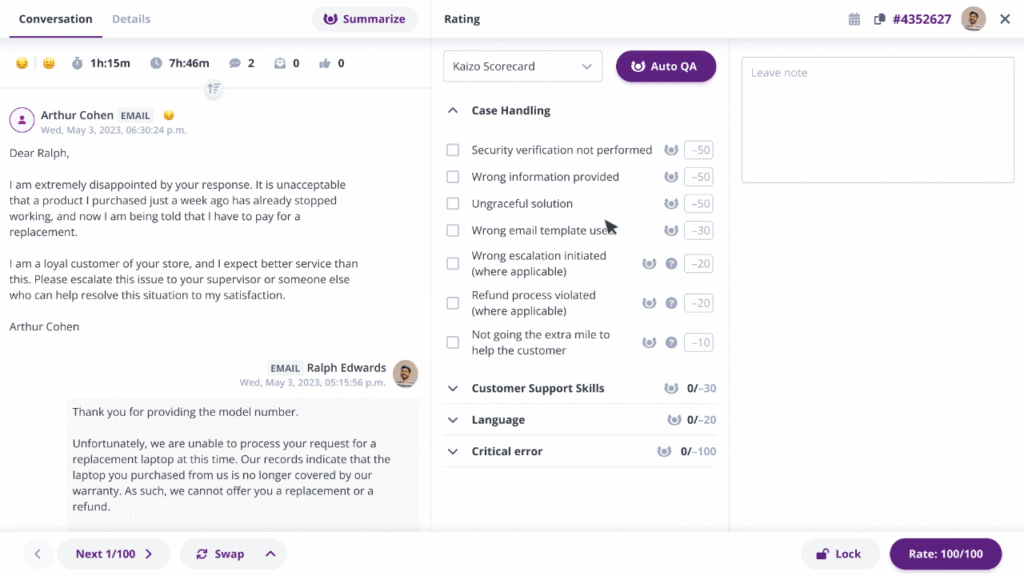
Kaizo is built on this model. Its AutoQA engine scores conversations against your scorecard automatically, and AutoPilot mode runs continuously in the background so coverage stays at 100% without anyone triggering a review. That turns the quality score on your leadership dashboard from an estimate into a number you can defend, and it frees your QA team from grading to focus on calibration and coaching. At UiPath, Kaizo automated 100% of QA, with a 200% ROI and an 8% lift in quality score.
See it on your own conversations. Kaizo scores 100% of your support conversations, human or AI agent, against your own criteria and turns the findings into coaching. Book a meeting.
AI QA tools for customer support, compared
Six AI QA tools come up most often for customer support teams: Kaizo, Zendesk QA, MaestroQA (Rippit), Level AI, EvaluAgent and Scorebuddy. All of them offer automated scoring; they differ on how much control you get over the AI’s criteria, whether the AI generates coaching, which helpdesks they connect to, and how they are priced.
| Tool | Best for | Custom AI criteria | AI coaching | Helpdesks named | G2 |
|---|---|---|---|---|---|
| Kaizo | Teams that want AI scoring on their own criteria, for human and AI agents | Yes | Yes | Zendesk, Salesforce (native) | 5.0 |
| Zendesk QA | Teams fully on Zendesk | Limited | No | Zendesk only | 4.5 |
| MaestroQA (Rippit) | Detailed manual scorecards and coaching sessions | Yes | No | Zendesk, Salesforce, Freshdesk, Helpshift | 4.7 |
| Level AI | Large teams that want hands-off automation | No | Yes | Zendesk, Salesforce | 4.6 |
| EvaluAgent | Agent-friendly feedback and ease of use | Yes | No | Zendesk, Intercom, Salesforce, Freshdesk | 4.5 |
| Scorebuddy | Teams new to formal QA | No | No | Zendesk, Salesforce | 4.5 |
Method: features as compared in our customer service QA software guide and on our comparison pages, G2 ratings as shown on G2, checked October 2026. Kaizo makes one of the tools in this table.
A few things the table does not show. Zendesk QA prices QA per helpdesk seat across the whole Zendesk account and charges for transcription; MaestroQA charges an onboarding fee. Level AI users on G2 report accuracy issues that need manual correction. For a vendor-by-vendor read, see the comparisons for Zendesk QA, MaestroQA and Level AI.
One scorecard for human and AI agents
If AI agents already answer some of your customers, the tool has to score those conversations too, against the same criteria as your people, or you end up with two quality numbers that cannot be compared. Kaizo scores human and AI-agent conversations side by side in one place, including the conversations Zendesk’s AI agents handle, and every deduction links to the lines in the transcript that caused it. See how AI agent QA works in Kaizo, and the guide to how to QA AI agents for what to score.
Capabilities to look for when choosing an AI QA tool
Once you understand what the category does, the buying decision comes down to a short list of things that actually differentiate one tool from another. Use these as your evaluation criteria.
- Coverage rate, stated honestly. Ask what percentage of conversations the tool scores automatically without a human trigger. “AI-assisted” often means it flags a few interactions for you to review, which is still sampling. The answer you want is 100%, continuous.
- Evidence behind every score. Each criterion result should point to the lines in the transcript that produced it, so a reviewer can check it in seconds and an agent can see why. See QA score traceability.
- Scorecard flexibility. Your standard is not generic, so a rigid template is a liability. Look for custom criteria, weighting, critical-error auto-fails, and separate scorecards per team, channel, or business line.
- Omnichannel evaluation. Modern support is voice, chat, email, and messaging. Quality has to be measured on all of them with one standard, not just on calls.
- Coaching output, not just scores. A score changes nothing on its own. The tool should turn evaluations into specific, per-agent coaching tied to real conversations. Kaizo generates AI coaching cards from actual quality data, which is what lets managers run a real coaching rhythm instead of assembling feedback by hand.
- A measurable quality score. You want an Internal Quality Score you can track by agent, team, and channel over time, and correlate against CSAT, so you can separate “the customer was unhappy” from “we performed poorly.”
- Calibration and human-in-the-loop. Automation should not mean you lose control. Good tools keep a path for reviewer calibration and let you keep human judgment on the genuinely hard cases.
- Platform fit and integration. It has to connect cleanly to the helpdesk you already run. If integration is painful, adoption stalls.
If you want the deeper comparison framework, our guide to customer service quality assurance software walks through the full evaluation in one place.
AI QA tools, in one comparison
Compared with manual QA, AI QA tools cover every conversation instead of 2 to 5%, apply one standard identically instead of varying by reviewer, report in near real time instead of weeks later, and scale without adding reviewers. Here is how the two approaches stack up on the dimensions that matter.
| Dimension | Manual QA | AI QA tools |
|---|---|---|
| Coverage | 2 to 5% of conversations | 100%, continuously |
| Consistency | Varies by reviewer and mood | One standard applied identically |
| Speed to insight | Days or weeks after the fact | Near real-time |
| Bias | Selection and reviewer bias baked in | Removed at the scoring layer, human calibration retained |
| Coaching | Compiled by hand from a small sample | Auto-generated from every conversation |
| Cost to scale | Linear: more volume needs more reviewers | Flat: coverage rises without headcount |
The point is not that AI replaces reviewers. It is that AI removes the grunt work of grading so your people spend their time on calibration, edge cases, and coaching, the parts that actually need human judgment. Before you trust any tool’s scores, test them against your own reviewers with the protocol in how to validate AI QA scoring.
When Kaizo is not the right pick
Kaizo is not the best AI QA tool for every team. If most of your volume is phone calls, look at voice-first tools or a contact-center suite with quality management built in. If your helpdesk is neither Zendesk nor Salesforce, check integration options first, since those are Kaizo’s two native integrations.
- You review a handful of tickets a week. A spreadsheet scorecard and a manual sample will do for now.
- You have no scorecard yet. AI applies your standard; it cannot invent one. Start with the customer service QA checklist.
- You want QA and workforce management in one contract. A WFM suite bundles both, at the cost of QA depth.
Frequently asked questions
What are the best AI tools for quality assurance?
The best AI QA tool is the one that scores 100% of your conversations against your own scorecard, works across every channel you support and turns scores into per-agent coaching. Rank candidates on coverage rate, scorecard flexibility, coaching output, and integration with your helpdesk, in that order. A tool that only transcribes or only tags sentiment is a feature, not a QA platform.
How does AI quality assurance work?
AI QA ingests conversations from your helpdesk, evaluates each one against a scorecard you define, scores and flags 100% of them, and generates coaching from the results. It uses natural language processing to read tone, intent, and content, and machine learning to apply your criteria consistently. The key difference from manual QA is coverage: it evaluates every conversation instead of a small sample.
Can AI replace human QA reviewers?
No, and the good tools do not try to. AI removes the manual grading work, scoring every conversation so reviewers no longer read tickets one at a time. Humans stay essential for calibration (making sure the standard is applied correctly), for judgment on genuinely ambiguous cases, and for the coaching conversations themselves. The model is automation for coverage, humans for judgment.
How accurate is AI quality assurance?
Accuracy depends almost entirely on the scorecard you give it. A clear, well-weighted standard with concrete criteria produces reliable, consistent scoring across 100% of conversations, more consistent than human reviewers, who drift and disagree. Vague criteria produce vague results. This is why defining your manual standard first, then calibrating the tool against it, matters more than any vendor’s model.
Can AI QA tools score AI agents and chatbots?
Some can. Look for a tool that scores AI-agent conversations against the same scorecard as human ones, so both appear in the same reports. Kaizo does this in one place, including the conversations Zendesk’s AI agents handle, with the transcript evidence attached to every score.
What is generative AI in quality assurance?
Generative AI in quality assurance means a large language model reads each conversation and scores it against your written criteria, with a comment explaining the result, instead of keyword rules or sentiment tags. It also drafts summaries and coaching. The scorecard you write still sets the standard; the model applies it.
Do AI QA tools work for chat and email, not just calls?
Yes. Modern AI QA tools evaluate voice, chat, email, and messaging against a single standard, which is essential because most support is now omnichannel. When comparing tools, confirm that omnichannel scoring is native rather than voice-only with text bolted on, since consistency across channels is itself a quality signal.
Choose on coverage, then on coaching
The AI QA market is loud, but the decision is simple once you strip the noise. Define your quality standard on paper first. Then choose the tool that scores 100% of your conversations against it and turns those scores into real coaching. Coverage tells you whether the score is real.
If you want to see what QA looks like at 100% coverage, scored automatically against your own scorecard and turned into coaching, explore AI auto QA and QA automation, or book a meeting and we will run it on your own conversations.