Customer service QA software scores support conversations against your quality scorecard, so you can find, coach and fix quality gaps across chat, email, calls and AI agents. The leading tools in 2026 are Kaizo, Zendesk QA, MaestroQA (now Rippit), Level AI, EvaluAgent and Scorebuddy. Kaizo fits teams that want AI to score every conversation on their own criteria; each of the others wins on something different: Zendesk fit, detailed scorecards, call-heavy automation, agent experience or easy onboarding.
Kaizo is our product. We include it where it fits and say what the others do better.
In short
- Kaizo scores every conversation against your own custom criteria and turns the results into AI coaching.
- Zendesk QA suits teams fully committed to the Zendesk suite, where QA is sold as an add-on for every agent.
- MaestroQA, EvaluAgent and Scorebuddy are strong on scorecards and ease of use, with coaching still written by a manager.
- Level AI goes furthest on call-heavy automation, and reviewers say its metrics need a second check.
- Ask every vendor to show the evidence behind a score, and how you calibrate it, before you sign.
The right tool directly affects agent performance, customer satisfaction and the ROI of your support operation. This guide compares the six leading customer service QA software platforms on the features that separate them, real user feedback, AI capabilities, coaching and integrations, so you can make a confident, informed decision.
Method: feature rows come from our comparison pages (last updated 21 October 2026), which draw on public G2 reviews, G2 verified-buyer figures and each vendor’s own site, checked again on 4 November 2026. Prices change often, so we describe each vendor’s pricing model rather than list prices.
Best QA scoring tool by use case
Pick by the situation you are in rather than by the longest feature list: team size, channels, whether AI agents already answer customers, and which helpdesk you run on. The quick picks below map each situation to the tool that fits it best.
| If you need | Best pick | Why |
|---|---|---|
| AI scoring on your own criteria, plus AI coaching | Kaizo | Criteria in your own words, coaching cards, every conversation scored |
| QA for a small team (1 to 25 seats) | Kaizo Insight plan or Scorebuddy | Kaizo’s Insight plan covers 1 to 25 seats, according to Kaizo pricing; Scorebuddy is an easy first QA tool |
| Chat and email QA on one scorecard | Kaizo or MaestroQA | Both apply one scorecard across written channels in your helpdesk |
| Human and AI agents on one standard | Kaizo | Scores AI-agent conversations next to human ones, including Zendesk’s AI agents |
| Everything inside Zendesk | Zendesk QA | Native, one vendor; QA is an add-on bought for every agent |
| A call-heavy contact center | Level AI | Built calls first, with near-full automated coverage per its reviewers |
Features that matter in customer service QA software
Customer service QA software is worth buying for seven features: automatic scoring of every conversation, custom weighted scorecards, evidence behind each score, calibration, coaching, reporting and native helpdesk integration. Use this table to check any tool you shortlist.
| Feature | What it does | What to check |
|---|---|---|
| Automatic scoring | Scores conversations against your scorecard without a reviewer starting each one | Does it cover every conversation, or a sample routed to reviewers? |
| Custom, weighted scorecards | Lets you write your own criteria, weights and auto-fails | Can you write criteria in your own words, per team or channel? |
| Evidence behind each score | Links every criterion result to the transcript lines behind it | Can an agent see why they lost a point in seconds? |
| Calibration | Keeps reviewers and the AI aligned on the same standard | Can you test the AI against your past ratings before it goes live? |
| Coaching | Turns scores into feedback for each agent | Is the coaching written for you, or still a manager’s write-up? |
| Reporting | Shows quality by agent, team, channel and over time | Can you set QA scores next to CSAT without a BI project? |
| Helpdesk integration | Reads conversations straight from the helpdesk or CRM | Native app, API, or manual import? |
Customer service QA software compared
The six tools differ less on whether they score conversations than on how: automatic coverage, an always-on mode, coaching written per agent, evidence behind each score and time to go live. The table compares them on those points.
| Feature | Kaizo | Zendesk QA | MaestroQA (Rippit) | Level AI | EvaluAgent | Scorebuddy |
|---|---|---|---|---|---|---|
| Automatic scoring of every conversation | Yes | Yes, per vendor | Partial (AI sold separately) | Yes | Yes | Yes, per vendor |
| Always-on mode, no review queue | Yes | Not compared | No | Partial | Partial | Not compared |
| Coaching written per agent | Yes | Partial | Partial | No | Partial | Partial |
| Every score traced to the conversation | Yes | Yes | Yes | No | Not compared | Not compared |
| Reporting without a BI project | Yes | No | Not compared | Partial | Partial | No |
| Native helpdesk or CRM integration | Zendesk, Salesforce | Zendesk | Partial | Call-centric | Not compared | Partial |
| Time to implement | Days | Setup-heavy | About 3 months | About 3 months | Setup-heavy | About 2 months |
“Partial” and “No” summarize what each vendor’s own reviewers say on G2, as quoted on our comparison pages for Zendesk QA, MaestroQA, Level AI, EvaluAgent and Scorebuddy. Implementation times are G2 verified-buyer figures. “Not compared” means the page has no row for it.
Top customer service quality assurance software and their strengths
The six strongest customer service QA tools in 2026 each win on something different. Kaizo leads on custom AI scoring and AI coaching, Zendesk QA on fit inside Zendesk, MaestroQA on detailed scorecards, Level AI on call-heavy automation, EvaluAgent on the agent feedback experience, and Scorebuddy on easy onboarding.
1. Kaizo
Users love: real-time performance in one place, efficiency
Best for: Customer support teams who need AI that works their way, not a fixed black box
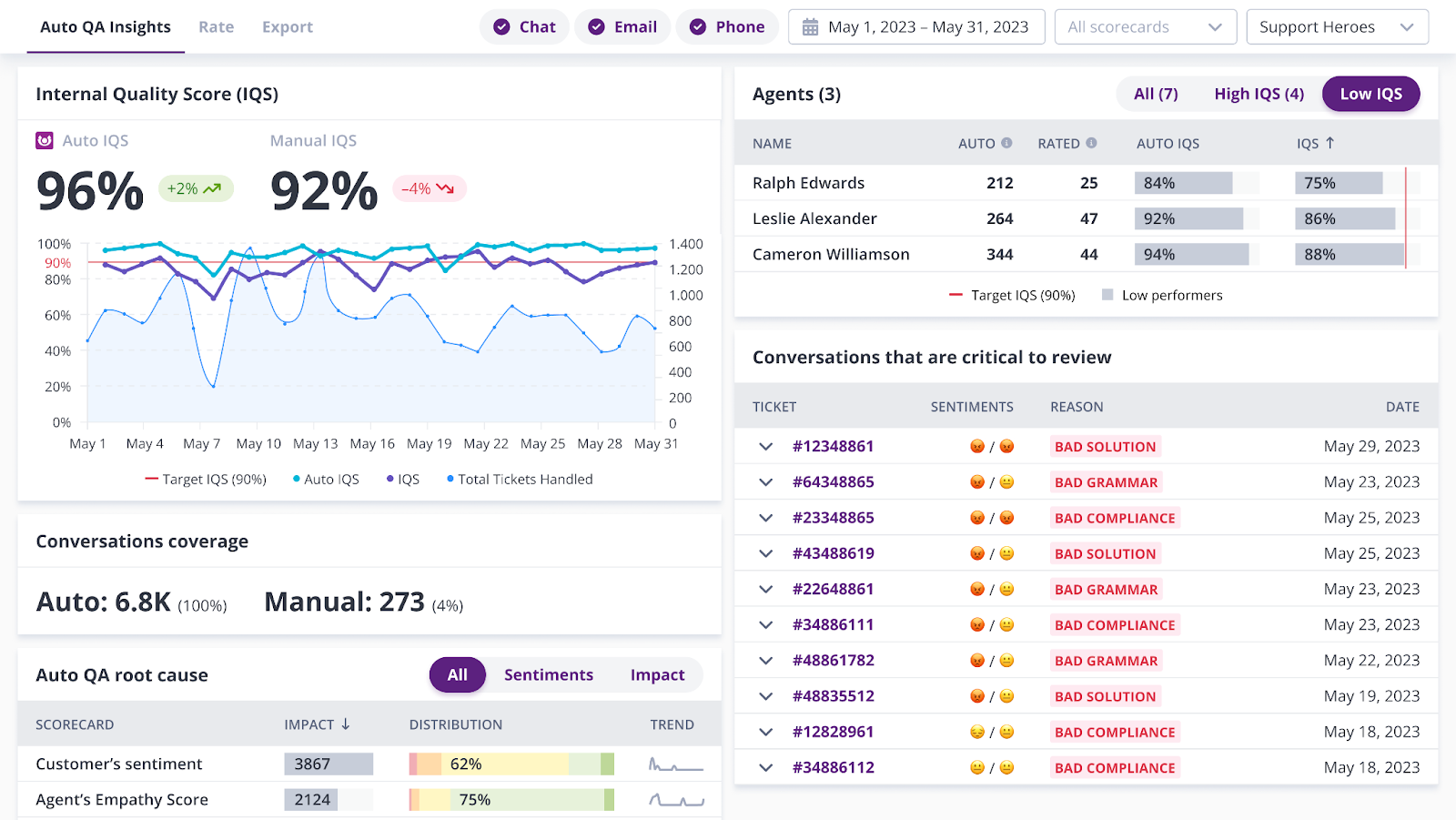
Kaizo was built from the ground up as a dedicated QA platform, with AI developed at an early stage to respond to real customer needs. Quality means something different to every company. Your customers are unique, and your support should be, too.
- Configurable performance dashboards with automated BI exports.
- Every conversation is scored automatically on AutoPilot, on every plan.
- The AI connects to your knowledge base, and you write detailed criteria for fully customized automatic scoring.
- Kaizo offers AI-generated coaching, with coaching cards written per agent from their own conversations.
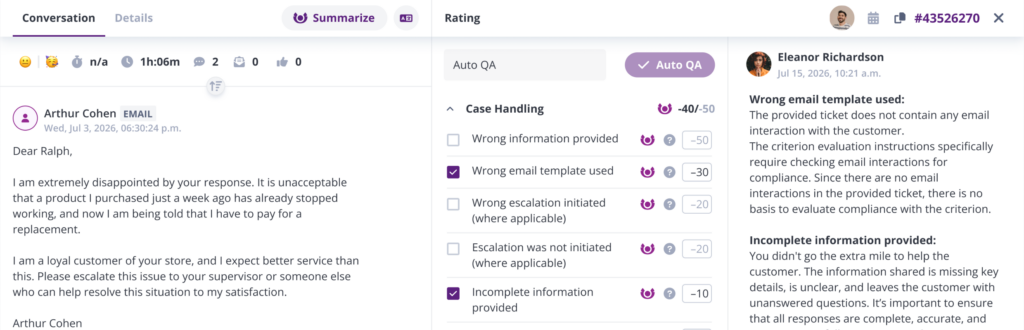
Use Kaizo’s AI to cover the full QA lifecycle: automated scoring of your support conversations, end-to-end coaching, and full performance insights and analytics. For when you want to dive in manually, Kaizo assists with features like calibration, assignments and BI exports.
Where Kaizo genuinely separates itself is in the depth of its AI customization. QA managers write their own scorecard criteria in plain language and connect the knowledge base for product context. This means our Auto QA evaluates conversations against your quality standards, not a generic template.
Kaizo connects natively with both Zendesk and Salesforce, and offers custom data retention and a custom storage location on the Enterprise plan rather than as paid add-ons. The Enterprise plan also includes influence over the product roadmap.
What it looks like in practice. At SteelSeries, AI summaries cut QA time in half on long, technical tickets.
See it in a live demo. Kaizo scores 100% of your support conversations against your own criteria and turns the findings into coaching. Let’s talk.
Strengths
- Flexible AI: criteria in your own words, knowledge base context, personalized AI coaching
- Purpose-built QA platform
- Customizable performance insight dashboards that support automated BI exports
- AI implementation workshops on the Enterprise plan to accelerate time-to-value
Limitations
- Native apps for Zendesk and Salesforce only; other systems connect through the API or a CSV import
- Built for support conversations after they end, not live in-call prompts
2. Zendesk QA
Users love: ease of use, efficiency, native Zendesk fit
Best for: Support teams running entirely on Zendesk who want QA within the same vendor relationship
Zendesk QA (formerly Klaus) makes the most sense if your team is already heavily invested in the Zendesk platform and you want to minimize vendor complexity. Its AI capabilities cover most of the core bases: autoscoring on built-in categories, custom AI categories you build, conversation summaries and sentiment, and Zendesk says it analyzes conversations across human and AI agents. For a feature-by-feature view, see our Zendesk QA alternative comparison.
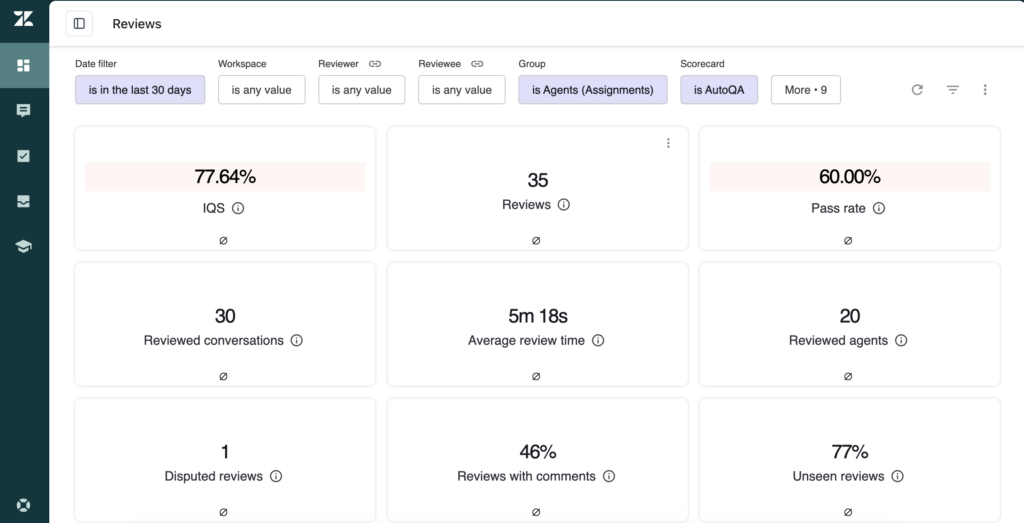
Reviewers like its scorecards and credit it with showing a team exactly where to focus. As an out-of-box solution inside Zendesk, Zendesk QA hits the main marks, and it is the better pick if you want QA, voice and workforce management from one vendor.
That said, Zendesk QA has a few notable limitations. Per-agent coaching is still a manager’s write-up. Call transcription is billed per minute (USD 0.01 post-call, 0.027 real-time), according to Zendesk’s transcription FAQ. And QA is sold as an add-on with no standalone price, bought for every agent; the Workforce Engagement bundle that includes it lists at $50 per agent per month billed yearly on Zendesk’s pricing page.
Strengths:
- Native Zendesk fit
- Strong AI suite
- User-friendly interface
Limitations:
- Built for Zendesk; QA is an add-on to a Support or Suite plan
- Transcription billed on top, per minute
- Reviewers call reporting basic and say setup grows complex as channels are added
- Add-on priced for every agent
3. MaestroQA (Rippit)
Users love: scorecard flexibility, coaching
Best for: Supporting a mature, manager-led QA and coaching workflow
MaestroQA, now rebranded as Rippit, built the coaching-led QA category and has a well-developed scoring system and coaching session structure. G2 reviewers consistently praise its scoring and the defensibility of its scores. Our MaestroQA alternative page compares it with Kaizo in detail.
From a feature standpoint, it covers the core QA and manual coaching toolkit well, with workflow-driven reviews your team configures and maintains.
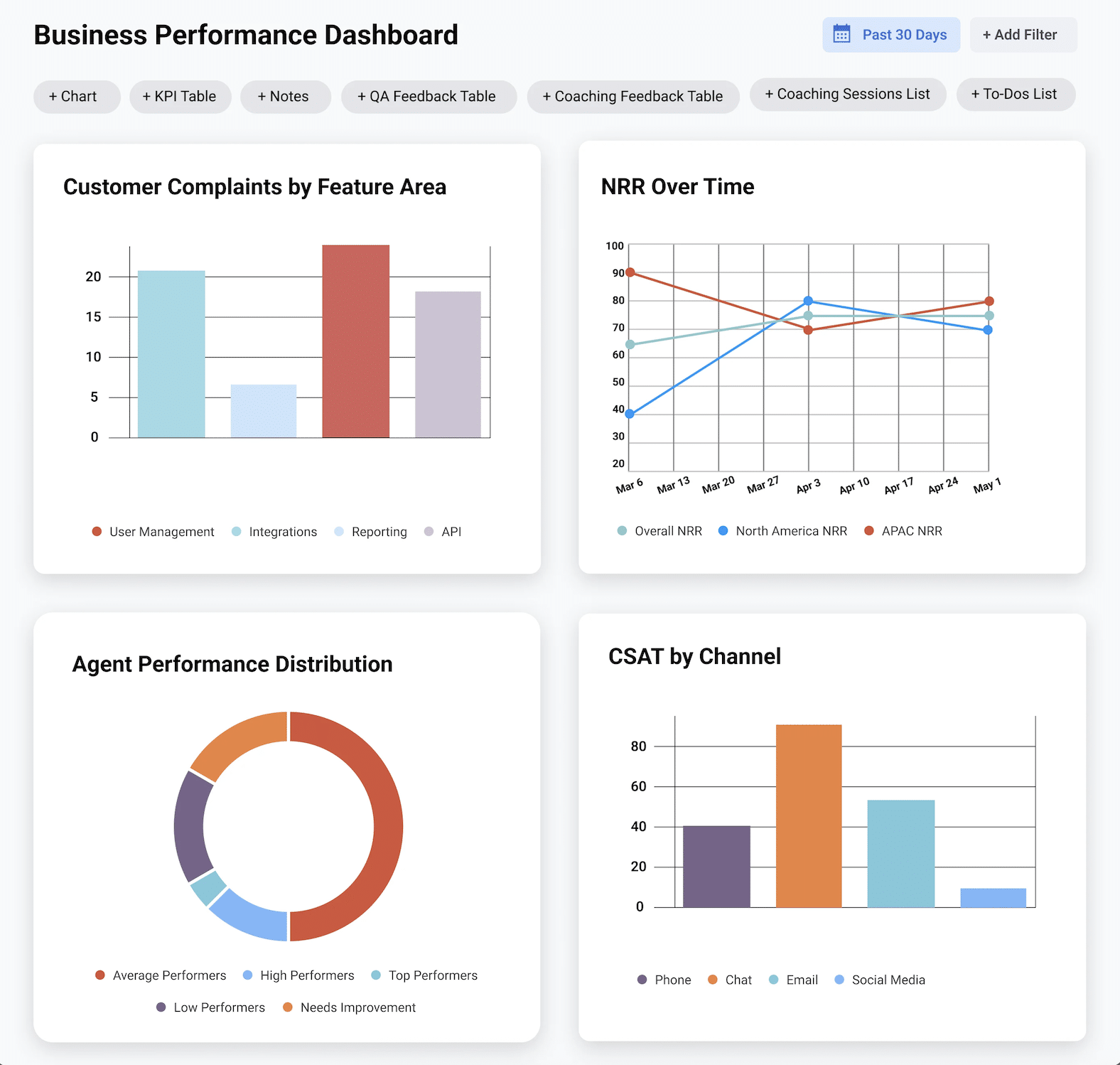
The recurring criticisms center on setup effort and integrations. Verified buyers report about three months to implement and about 18 months to ROI, reviewers cite integration limits, and AI scoring is sold as a separate purchase, which reviewers say raises the cost significantly.
Strengths:
- Detailed scoring system
- Strong coaching session structure
- Mature QA workflows
Limitations:
- AI scoring sold separately
- Coaching analysis and write-up stay with the manager
- Long implementation, per verified buyers
4. Level AI
Users love: ease of use, clean interface
Best for: Large, call-heavy contact centers moving from sampling to near-full automation
Level AI takes the AI-first path and has built genuine momentum with teams that value a more hands-off approach to QA. G2 reviewers frequently cite time savings from automated call documentation, and one Enterprise reviewer reports moving from a small manual sample to near-full automated coverage. See the Level AI alternative comparison for the full picture.
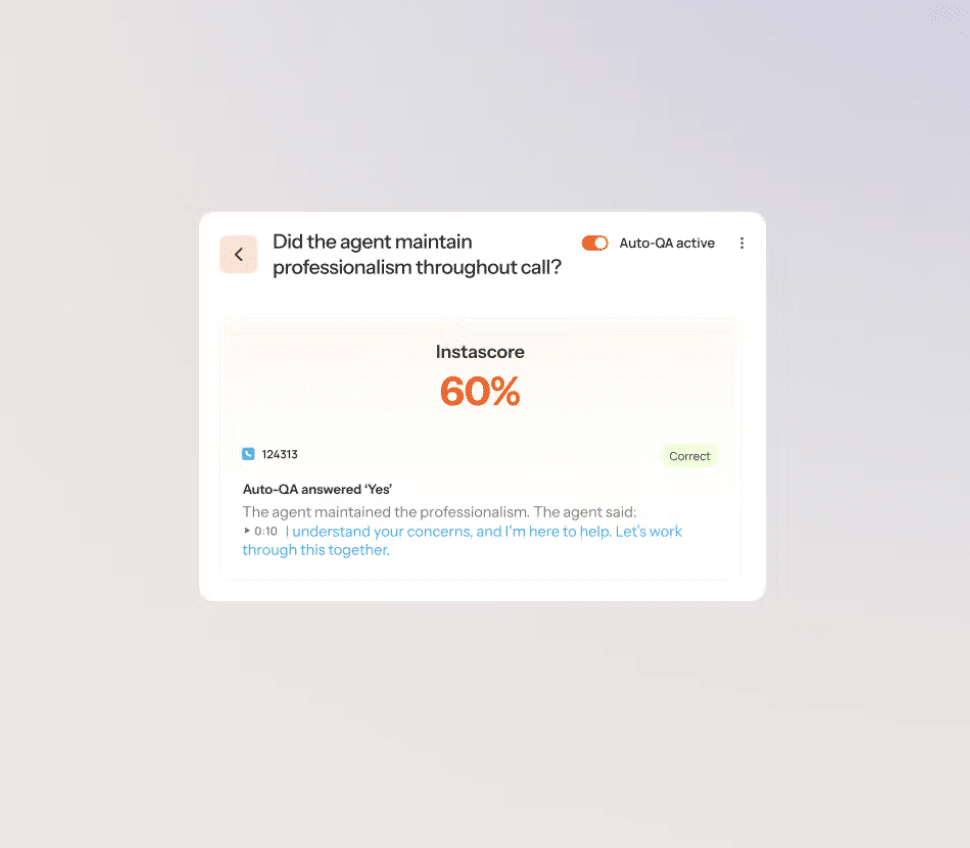
As with many AI-first tools, the most consistent complaint across customer reviews is accuracy: reviewers describe data that is hard to fully trust without secondary validation, and one says it is occasionally unclear how certain metrics are calculated. An Enterprise customer says the coaching feature has not been very accurate and has not been adopted.
For more mature QA teams, configuration is the other friction point: reviewers say setting up labels, categories and dashboards takes more trial and error than they would like, and verified buyers report about three months to implement.
Strengths:
- Near-full automated coverage on calls
- Time saved on call documentation
Limitations:
- Reviewers say metrics need a second check
- Coaching not adopted, per an Enterprise customer
- Call-centric
5. EvaluAgent
Users love: ease of use, navigation
Best for: Teams where ease of use and agent engagement are the top priorities
EvaluAgent’s strongest asset, according to customers, is the clarity of its feedback experience for agents. Agents can query a score they disagree with, and reviewers say it cuts the time spent on manual reviews. Our EvaluAgent alternative page compares the two tools side by side.
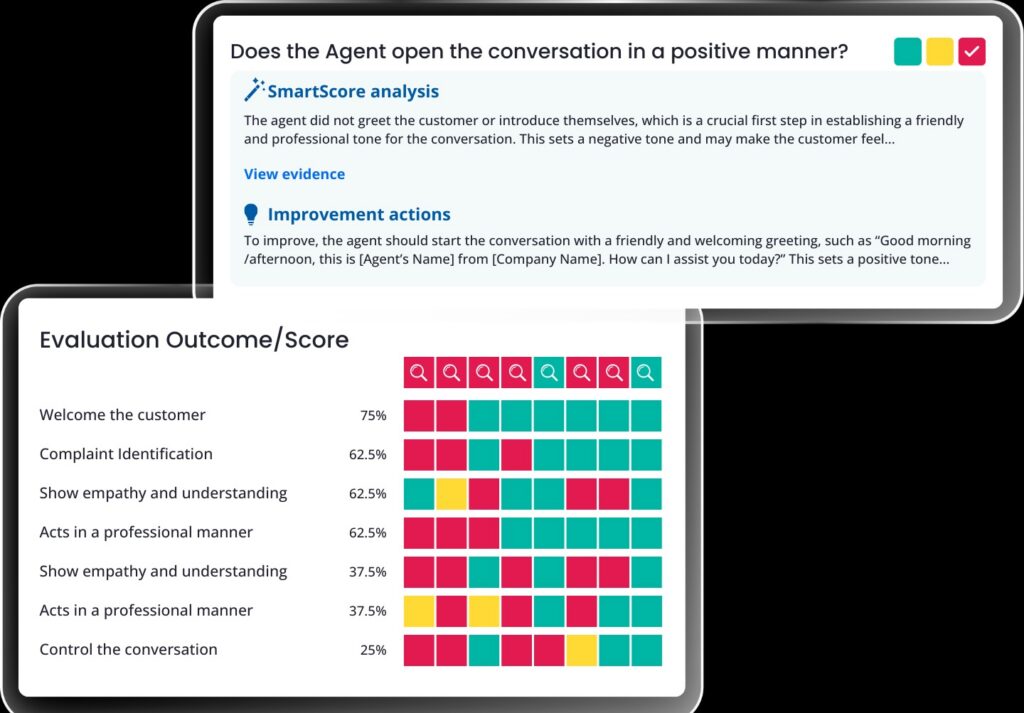
On the feature side, EvaluAgent covers the QA basics competently: automated scoring, auto queues that assign work fairly to evaluators, and coaching sessions and plans that keep agent progress in one place.
However, conversations are still routed to an evaluator rather than scored without a queue, and the coaching analysis and write-up stay with the manager. Even happy reviewers name scorecard design as the main setup challenge, and filtering friction in reporting is a top complaint tag.
Strengths
- Great agent-facing feedback experience
- Agents can challenge scores
- Strong ease of use
Limitations
- Work still routed to evaluators
- Scorecard setup takes time
- Reporting takes work to get the right view
6. Scorebuddy
Users love: scorecard builder, coaching
Best for: Teams new to formalized QA who need a low-friction starting point
Scorebuddy’s dominant theme is accessibility. Reviewers say its scorecards are easy to build, customize and update without heavy technical work, which makes it a good starting point for teams new to quality assurance. See the Scorebuddy alternative comparison for details.
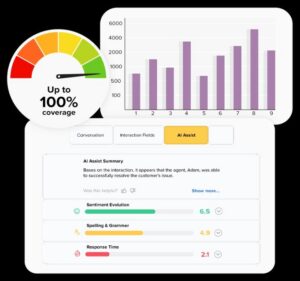
From a feature standpoint, however, it falls short of the other quality assurance tools listed above. Poor reporting is its most-tagged G2 complaint, and reviewers without a ticketing integration describe entering conversations by hand, which caps what AI scoring can cover.
Scorebuddy is a reasonable starting point for smaller teams, but companies that expect to grow their QA program in sophistication are likely to find themselves constrained.
Strengths
- Easiest onboarding
- Strong usability ratings
- Effective for basic QA workflows
Limitations
- Limited reporting
- Integration limits reported by reviewers
Call center and contact center quality assurance software
Call center quality assurance software adds voice to the job: it transcribes calls, scores them on the same scorecard as chat and email, and flags compliance misses on every call rather than a sample.
What changes for voice is the input. Look for accurate transcription in your languages, criteria that work on spoken conversations (verification steps, required disclosures, hold and transfer handling), and the same evidence link from each score to the moment in the call. Kaizo scores calls, chats and emails in Zendesk on one scorecard (contact center QA); if voice is most of your volume, also compare voice-first tools such as Observe.AI or a contact center suite with quality management built in. Our guide to call center quality assurance covers the program around the software.
Other customer service QA tools to consider
The six platforms above compete most directly with Kaizo on customer service QA. The tools below also handle QA, but each is better known for an adjacent strength (workforce management, voice and CCaaS, or real-time agent assist), so they suit teams whose primary need sits outside pure quality assurance.
| Tool | Best known for |
|---|---|
| Playvox (now NICE) | QA bundled with workforce management and gamification; digital-first |
| Observe.AI | Voice-first conversation intelligence and auto-QA for contact centers |
| Cresta | Real-time, in-call agent guidance powered by generative AI, at enterprise scale |
| Loris | Conversation intelligence for digital support, now part of Contentsquare |
| NICE CXone | A full enterprise CCaaS suite with quality management built in |
| Verint (with Calabrio) | Workforce engagement suite, now including Calabrio ONE, with automated quality management for larger contact centers |
How to choose the right customer service QA software
Choose customer service QA software by your biggest constraint: control over scoring criteria, how hands-off QA should be, your helpdesk, and how mature your QA program is. The four questions below map each situation to a tool.
Do you need AI that scores on your own quality criteria?
Kaizo combines AI customizability with fully developed customer service quality assurance capabilities. It is a complete option for mature QA teams who know their customers expect more than standard service.
Do you want a completely hands-off approach to QA?
Level AI leans furthest into automated scoring on calls. The tradeoff its reviewers describe is trust: metrics they want to check a second time. Kaizo also scores every conversation automatically but with a dial: you choose how much humans review, and every score links to its evidence, so you get full coverage without giving up oversight of how your team is graded.
Are you on Zendesk and want everything in one place?
Zendesk QA is the path of least resistance if you’re all-in on Zendesk. But Kaizo is a Zendesk partner with a native app too, so “keeping everything in one place” isn’t a reason to settle: you get QA inside Zendesk plus custom AI scoring and coaching, without buying a bundled suite.
Are you early in your QA journey?
Scorebuddy and EvaluAgent are genuinely easy to start with. So is Kaizo: begin with a ready-to-use scorecard and let AI score from day one. The difference is that you won’t outgrow it, because the same tool scales from your first scorecard to a mature, fully automated QA program.
As AI agents take on more of the work, QA software also has to keep up with agentic customer service: Kaizo’s Agentic Platform, running as a pilot in Q4 2026, adds role-based AI agents that evaluate conversations, investigate patterns and prepare reports inside your helpdesk. For how the AI scoring itself differs between tools, see our guide to AI quality assurance tools for customer support.
When Kaizo is not the right choice
Kaizo is not the best pick for every team. If your helpdesk is not Zendesk or Salesforce, check integration options first, since those are Kaizo’s two native integrations. If you handle a handful of tickets a week, a spreadsheet scorecard and a manual sample may be all you need for now.
- You have no scorecard yet. Agree on what good looks like before buying software. Our guides to service quality assurance and building a QA scorecard are the place to start.
- You need live, in-call agent prompts. Kaizo scores conversations after they end; real-time assist tools such as Cresta are built for the live call.
- You want QA and workforce management in one contract. A suite like Playvox or Calabrio ONE bundles both, at the cost of QA depth.
A buyer’s checklist before you sign
Whichever tool you shortlist, run it through the same questions before you commit: suite or standalone, the must-have features, pricing, scalability, usability and proof. Most of them only get a straight answer in a live demo, not from a feature page, so write your questions down first. Our QA software pilot plan shows which success criteria to write down and how to compare vendors against the same criteria.
Standalone or part of a suite. A dedicated QA platform goes deeper on scoring, calibration and coaching. QA bundled into a helpdesk, WFM or CCaaS suite gives you everything in one contract but is usually shallower, and it ties your quality standard to that vendor’s roadmap. Decide which trade you are making.
The must-haves.
- Helpdesk integration. Reviewers should score inside the tool your agents already use (Zendesk, Salesforce and so on), with ticket metadata available, not in a separate system fed by exports.
- Every channel on one standard. Voice, chat, email and messaging scored against one core scorecard, so a quality score means the same thing everywhere.
- Weighted, customizable scorecards with auto-fail criteria, so the tool measures your definition of quality rather than a generic template.
- Automation with evidence. Automated scoring should cover every conversation and link each score to the part of the transcript that produced it.
- Alerts and real-time reporting, so critical issues and quality dips surface while they can still be fixed, not at month end.
- Exports, CSV or BI, so QA results can sit next to CSAT, handle time and the rest of your reporting.
Pricing questions to ask (Kaizo’s plans are on the pricing page). Is the price per QA seat, per agent or per helpdesk seat (wall-to-wall)? Are transcription, AI scoring or extra storage charged on top? Are there onboarding or training fees? And what return does the vendor expect, in reviewer hours saved and quality gained, and how will you measure it?
Scalability. Check the tool copes with your forecast headcount, multiple sites and time zones, and outsourced teams on the same standard, since that is where most QA programs strain.
Usability. The tool becomes part of your reviewers’ and agents’ daily routine, so look hard at the onboarding effort, how much ongoing training it needs, and what help is available. Ask to see both the reviewer view and the agent view in the demo.
Proof. Read customer stories and independent reviews rather than taking the vendor’s word for it, and ask for a reference in a team that looks like yours.
Ready to compare? See how Kaizo scores every conversation against a scorecard and turns it into coaching, or book a meeting for a live demo with realistic sample conversations.
Related reading
- Kaizo vs Zendesk QA, Playvox, Scorebuddy, EvaluAgent and MaestroQA: head-to-head comparisons
- Conversation intelligence software: a buyer guide
- The ROI of Auto QA
- Manual QA vs Auto QA compared
- How to build a customer service QA program from scratch
Frequently asked questions
What are the best QA scoring tools for customer support?
The leading QA scoring tools in 2026 are Kaizo, Zendesk QA, MaestroQA (Rippit), Level AI, EvaluAgent and Scorebuddy. They differ most on coverage and customization: Kaizo scores every conversation against your own custom criteria and writes the coaching, while several others route a share of conversations to reviewers, sell AI scoring separately or leave coaching to the manager. Pick on coverage first, then on coaching.
What tools audit support ticket quality?
Support ticket quality audit tools review conversations against a scorecard to check whether they were handled well. Manual auditing covers a small sample, so quality depends on which tickets happen to be picked. AI-driven QA platforms like Kaizo audit every ticket automatically and link each score to the evidence in the transcript, so quality gaps show up as a trend instead of luck of the draw.
Which QA tools work across multichannel support?
For QA across several channels you need one scorecard applied to every channel, rather than a single-channel tool. Kaizo applies your own criteria to calls, chats and emails in your helpdesk; MaestroQA, EvaluAgent and Scorebuddy also cover multiple channels, and Zendesk QA is scoped to Zendesk channels. Contact centers can read more in our guide to call center QA software.
Which QA tool is best for a small support team?
For a small team, pick a tool that is quick to set up and priced for a few seats. Kaizo’s Insight plan covers 1 to 25 seats and scores every conversation from a ready-to-use scorecard, and Scorebuddy is an easy first QA tool. With only a handful of tickets a week, a spreadsheet scorecard may be enough until volume grows.
Which QA tools have customizable scorecards?
Most QA tools offer scorecards, but customization depth varies. Kaizo lets QA managers write their own scoring criteria in plain language, with weights and auto-fails, and connect the knowledge base for context. MaestroQA offers detailed manual scoring, and Scorebuddy’s scorecards are easy to build and update. Check how many custom automated criteria each plan includes before you compare prices.
Who provides QA dashboards for support analytics?
QA dashboards turn conversation scores into trends by team, agent and channel, so you can see where quality is slipping. Kaizo includes configurable performance dashboards with automated BI exports, so QA results feed directly into customer service metrics and KPIs and coaching. Reporting depth is where tools differ most: several reviewers of other QA tools say they need extra configuration or a BI tool.