TL;DR: To improve call center agent performance, work three levers in order. First, measure honestly, track the few metrics that map to your goals and score conversations across the whole team, not a 5% sample. Second, coach the behaviors behind the numbers, from real conversations, on a fixed weekly cadence, not just when something goes wrong. Third, motivate and retain, with recognition, autonomy, career paths, and an eye on burnout. Below are concrete tactics for each lever, each with the signal that tells you it worked.
Call center agent performance is how effectively an agent handles customer conversations: accurately, efficiently, and in a way that leaves the customer satisfied. It is the single biggest driver of your service quality, and the thing most teams try to improve with vague pep talks instead of a plan.
This guide is the plan. A short setup on what to measure, then the deepest part: exactly how to improve performance, grouped by the three levers that actually move it.
What goes into call center agent performance?
Every role has objectives, and agents are no different. Good performance is a blend of three things:
- Effectiveness: does the agent resolve the customer’s issue correctly, first time, without an escalation or a callback?
- Efficiency: does the agent handle the conversation at a reasonable pace, without dead air, unnecessary transfers, or bloated after-call work?
- Experience: does the customer come away feeling understood? Tone, empathy, and clarity are as measurable as handle time, and they matter more to loyalty.
The mistake is optimizing one at the expense of the others. Push handle time down hard enough and first-contact resolution falls, because agents rush customers off the line. Real performance improvement moves the outcomes without degrading the experience.
How do you measure call center agent performance?
You cannot improve what you do not measure honestly, so measurement comes first. The list of things you could track is almost endless. The discipline is picking the few that map to your goals and ignoring the rest as noise.
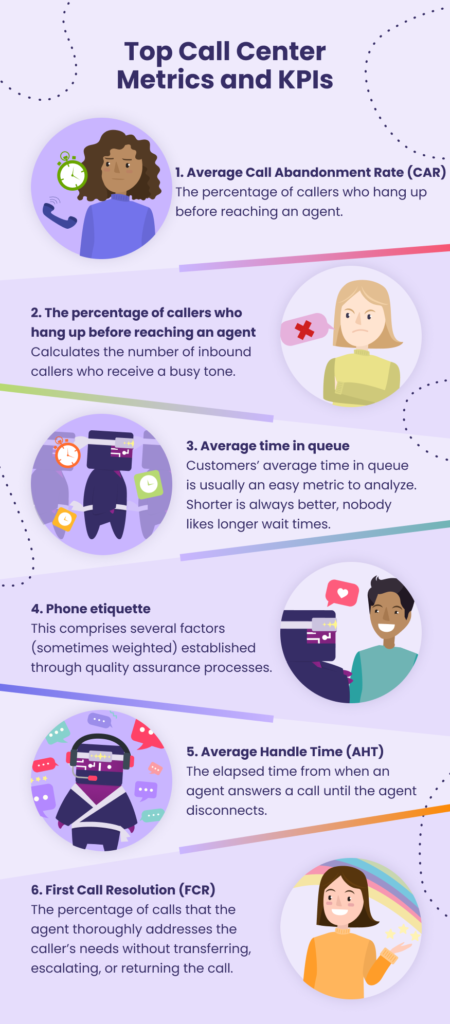
A workable core set of call center performance metrics and KPIs:
| Metric | What it tells you | Watch out for |
|---|---|---|
| First contact resolution (FCR) | Whether the issue actually got solved | Reopened tickets hiding as “resolved” |
| Customer satisfaction (CSAT) | How the customer felt | Only the fraction who respond |
| Average handle time (AHT) | Efficiency | Gaming it by rushing customers |
| Quality score (QA/IQS) | Whether the agent followed the standard | Only as good as your sample size |
| Reopen and transfer rate | Hidden rework and hand-offs | Easy to ignore until it compounds |
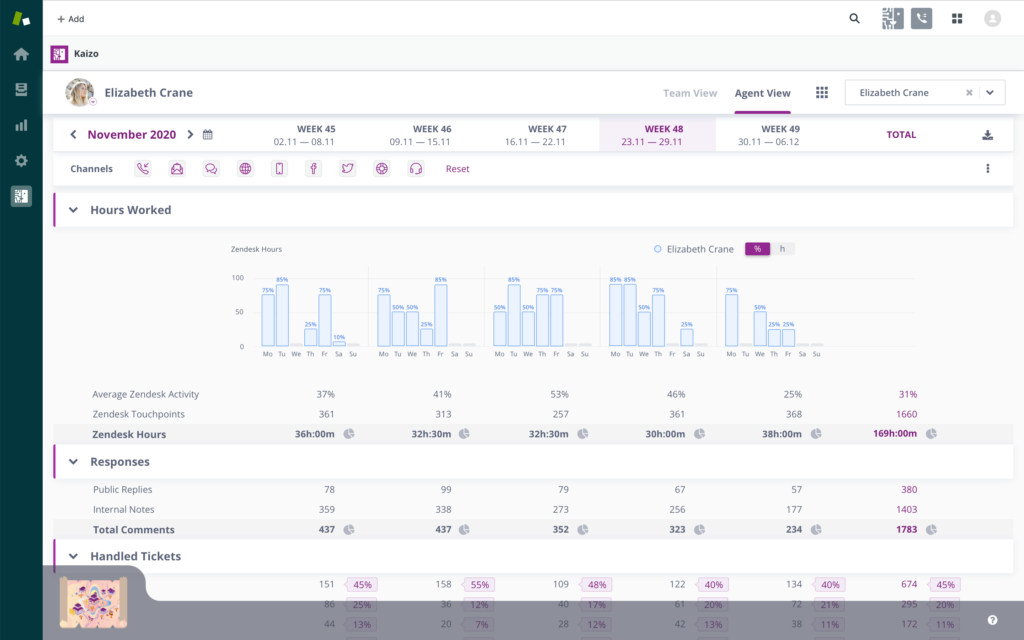
The hard part is not collecting the data, it is turning it into something actionable per agent. Dumping fifty metrics into a spreadsheet every week is not measurement, it is bookkeeping. You need a view that shows each agent’s real-time performance against the standard, and lets you spot your top and bottom performers at a glance. Kaizo’s Agent Scorecard does this per agent and updates in real time, and the Team Scorecard rolls it up so you can see where the whole team stands without building the report by hand.
One caveat that shapes everything below: your quality score only describes the conversations you actually reviewed. If that is three to five tickets per agent per week, under 5% of the total, you are coaching on a thin, possibly biased slice. Keep that in mind as we get to the tactics.
How to improve call center agent performance
Here is the part the slug promises. Improving performance is not a random list of tips, it is three levers pulled in order: measure honestly, coach the behaviors behind the numbers, then motivate and retain the people doing the work. Skip a lever and the others leak. Below is each one, with concrete tactics and a way to know it worked.
Lever 1: Measurement, get an honest baseline
You cannot coach what you cannot see, and you cannot prove improvement without a before and after. This lever is about making the score trustworthy before you act on it.
- Define the metrics that map to your goal, then stop. Pick the three or four that reflect the outcome you want this quarter (say FCR and CSAT if the goal is resolution quality) and make those the ones you review. Every other KPI is context, not a target.
- Build a strategic QA framework. A defined call center QA framework turns “good service” into concrete, weighted criteria you can score every conversation against: accuracy, tone, empathy, process adherence, resolution. Without it, “performance” is an opinion.
- Cover more than a sample. A 5% manual sample produces two problems: statistical noise, where one bad call swings an agent’s score, and selection bias, where reviewers pick easy or already-flagged tickets. The wider your coverage, the closer the score gets to reality. This is the single biggest lever on measurement quality, and the one manual QA struggles with most.
- Measure every channel, not just calls. Modern support is omnichannel. If you only score voice, chat and email drift. Hold the same standard everywhere.
It worked if: you can state each agent’s performance with a number you would defend in a review, and explain what drove it.
Lever 2: Coaching, turn scores into behavior change
Measurement tells you where the gaps are. Coaching is what closes them, and it is where the biggest performance gains come from. First, a distinction the old playbook blurs.
Training and coaching are not the same thing. Training shares knowledge and teaches skills: how the product works, what the policy is, which macro to use. Coaching reinforces those skills in live work, spots where they break down, and helps the agent adjust. You need both, but coaching is the one that drives sustained performance improvement, because skills fade without reinforcement.
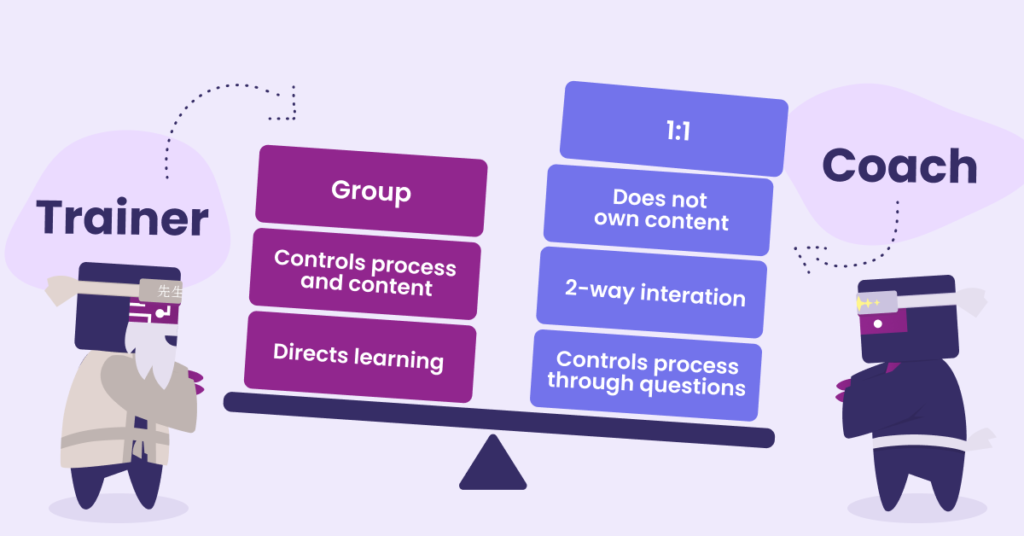
MIT describes coaching as a “partnership between the manager and employee that creates a shared understanding about what needs to be achieved and how it is to be achieved.” That word, partnership, is the point. It is not a hierarchy where agents are subordinates, and not a free-for-all where everyone has equal say. It is a balance built on mutual respect, and getting that balance right is what makes a team both better and more loyal.
The tactics that make customer service coaching actually move performance:
- Coach from real conversations, not memory. “Be warmer” is not coachable. “On this ticket you jumped to the solution before acknowledging the customer was frustrated, here is where” is. Ground every session in specific, recent interactions.
- Coach the pattern, not the incident. One rough call on Friday should not drive Monday’s session. Coach from trends across many conversations so you fix behavior, not react to a single data point.
- Set a fixed weekly cadence and hold it. Feedback that only shows up when something breaks feels like being called to the principal’s office. A steady weekly rhythm makes coaching normal, expected, and far more effective. Decide the cadence up front and treat it as fixed.
- Balance positive with corrective. Reinforce what the agent does well, not just what they miss, and frame corrections as concrete next steps. Specific and forward-looking beats vague criticism every time.
- Be specific about soft skills. Even empathy is coachable when you name the behavior: acknowledge the customer’s issue in your own words before offering a fix. Give real examples of what good sounds like, without turning it into a robotic script.
- Catch coachable moments early. A mistake made once is fine. The same mistake repeated for three weeks because nobody flagged it is a performance problem you created. Surface the moment while it is still fresh.
- Listen back to your agents. The people taking the conversations know which processes are broken. Implementing their ideas lifts efficiency and morale at the same time, and it signals that coaching runs both ways.
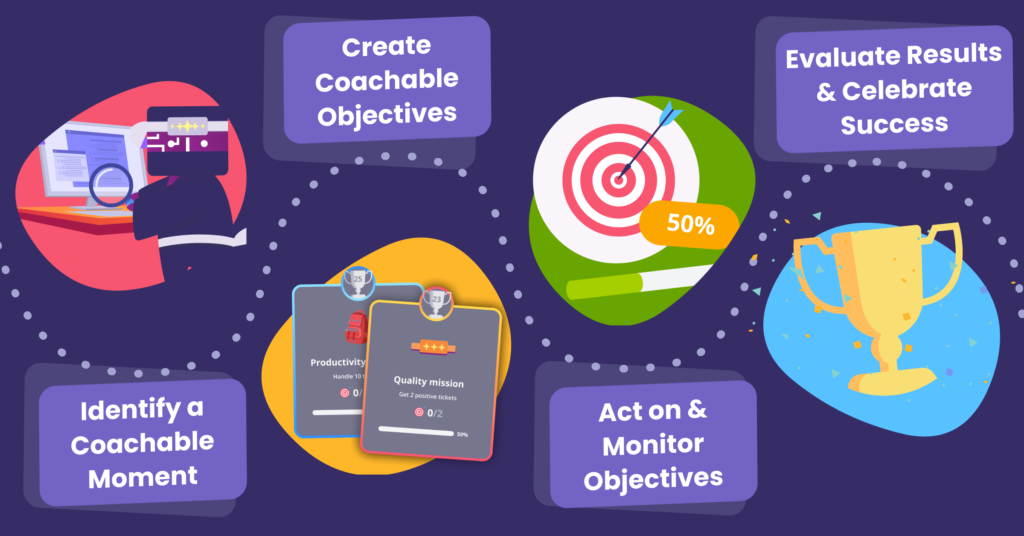
The bottleneck here is manager time. Preparing evidence-based coaching for a full team, pulling the right conversations, spotting the pattern, writing it up, can eat a team lead’s entire week. Kaizo generates AI coaching cards per agent from real quality data, so managers arrive at each session with the pattern and the examples already assembled and spend their time coaching instead of compiling.
It worked if: the specific behavior you coached improves at the next quality review, and the improvement holds for more than a week.
Lever 3: Motivation, keep good performance from decaying
The best-measured, best-coached agent still underperforms if they are disengaged or burning out. This lever is about the conditions that make good performance sustainable.
- Recognize improvement, visibly. Agents who see their own real-time scores and get acknowledged for progress take ownership of their numbers. Recognition is cheaper than attrition and works better than pressure.
- Give autonomy and career paths. Let agents specialize and become the expert on a product area or queue. It raises job satisfaction, deepens skill, and gives them somewhere to grow toward, which is what keeps good people from leaving.
- Make progress feel like progress. Framing KPIs and daily targets as goals and challenges, rather than a corporate scorecard, makes the work more engaging. Kaizo’s Mission Center lets you set goal-aligned missions agents complete and level up on, giving you a natural moment to deliver real-time feedback. Use it as a light layer on top of real coaching, not a substitute for it.

- Watch for burnout, not just skill gaps. A sustained performance dip is often fatigue, not a training need, and coaching the wrong one makes it worse. Our guide to call center burnout covers the warning signs so you can tell them apart.
- Hire and staff for it. Communication, problem-solving, and emotional intelligence can be coached, but starting with people who have them, and staffing so nobody is permanently underwater, makes every other lever easier.
It worked if: your top performers stay, and quality scores hold steady through busy periods instead of collapsing under load.
Manual limits, and how AI auto-QA changes the math
Every lever above runs into the same wall: manual review only covers a sliver of conversations, so your baseline is thin, your coaching evidence is partial, and your improvements are hard to prove. You can review more by hand, but it costs reviewer hours you do not have.
This is why QA has become more than a scoring chore. Gartner research found 52% of QA leaders now say their program’s primary value is voice-of-the-customer insight, not rep scoring, because the conversations hold the richest signal a support org has about its customers and its agents. To use that signal, you need coverage.
AI auto-QA removes the sampling ceiling. Instead of scoring three to five tickets per agent, it evaluates every conversation against your scorecard. Kaizo’s AutoQA scores conversations automatically, and its Autopilot mode runs continuously in the background so coverage stays at 100% without anyone triggering reviews. That turns your performance baseline from an estimate into a measurement, and frees your leads from grading to spend their time coaching. Purpose-built QA software is what makes measuring and improving performance at scale realistic rather than aspirational.
The results at real accounts are concrete. UiPath automated 100% of its QA, with 200% ROI and an 8% lift in quality score, and EverHelp cut coaching-prep time by 75%. Automation is a dial you turn up over time, not an all-or-nothing switch, and teams keep human review where judgment genuinely matters.
One point specific to this moment: as contact centers add AI agents to the queue, someone has to score the performance of those AI agents too. Kaizo scores 100% of human and AI-agent conversations against your own scorecard, and every score links to the evidence in the conversation, so both are measured on the same terms as your center becomes a mix of the two.
Frequently asked questions
How do you improve call center agent performance?
Work three levers in order. Measure honestly, track the few metrics that map to your goals and score conversations across the whole team, not a small sample. Coach the behaviors behind the numbers, from real conversations, on a fixed weekly cadence. Then motivate and retain, with recognition, autonomy, career paths, and attention to burnout. Start with the metric that matters most this quarter and coach the single behavior most likely to move it.
What are the most important call center agent performance metrics?
The core set is first contact resolution (did the issue get solved), CSAT (how the customer felt), average handle time (efficiency), a quality or internal quality score (did the agent follow the standard), and reopen or transfer rate (hidden rework). Track the few that map to your current goal and treat the rest as context, not targets.
What is the difference between training and coaching in a call center?
Training shares knowledge and teaches skills: product, policy, tools. Coaching reinforces those skills in live work, spots where they break down, and helps the agent adjust. Training gets an agent ready; coaching keeps them improving. Sustained performance gains come mostly from coaching, because skills fade without reinforcement.
How often should you coach call center agents?
Set a fixed cadence, weekly is a common and workable rhythm, and hold it regardless of whether anything went wrong. Regular, expected coaching normalizes feedback and lets you catch problems while they are small. Ground each session in specific recent conversations and coach the pattern across many, not a single incident.
How do you motivate underperforming call center agents?
Diagnose first: a sustained dip is often burnout or a broken process, not a skill gap, and each needs a different response. For genuine skill gaps, give targeted coaching with specific examples and recognize improvement visibly. Add autonomy, specialization, and career paths so agents have somewhere to grow, and make sure staffing does not leave anyone permanently overloaded.
Start with measurement, sustain with coaching
Improving call center agent performance is not complicated in principle: see the work honestly, coach the behaviors that drive it, and keep your best people engaged. What breaks most programs is the first lever, you cannot improve performance you only sample. Get measurement and coverage right, coach from real evidence on a steady cadence, and protect motivation, and performance compounds instead of drifting.
If you want to see agent performance measured across 100% of your conversations and turned into per-agent coaching, book a meeting and we will run it on your own queue.